
Most companies
are not prepared for the AI era.
The gap is not awareness — every executive is talking about AI. The gap is organizational readiness. These are the structural debts that keep AI from compounding.
- 01
Slow decisions
Critical context lives in slides, threads and inboxes. Leaders decide on yesterday's reality.
≈ 11 daysavg decision lag - 02
Disconnected systems
ERP, CRM, ticketing, drives. Each owns a fragment. None knows the whole.
38avg systems / mid-cap - 03
Repetitive work
Reports, decks, summaries, plans. Built by hand every quarter, by people who could be operating.
63%time on rebuilds - 04
Fragmented knowledge
Tribal memory. When a senior leaves, a year of context leaves with them.
0org-level memory - 05
Weak customer ownership
Aggregators own the relationship. The operator has no asset to compound.
∅first-party CRM
One substrate. Five surfaces. The whole organization, observable.
ORYXA connects people, workflows, knowledge and operational systems into a single intelligence layer — and lets AI execute across all of it. Not a chatbot. Not a copilot. Infrastructure.
Continuous organizational memory
Every decision, every artifact, every signal — captured at the seam, not in a slide.
AI decision support, by role
Forecasts, risk surfaces, recommendations — scoped to who is asking and what they own.
Execution, not just answers
Generated decks, routed actions, drafted plans. Outputs that ship, not that summarize.
The CEO asks.
The company answers.
ORYXA collapses the hierarchy between a question and an action. An executive asks once. The intelligence layer remembers, reasons, writes, and ships. No analyst chain. No middle layer.

Visualize your resources with AI.
VYRA turns underused seismic recordings into reviewable physical evidence — and, over time, into a shared knowledge base for every exploration block. A working analysis engine today; a decision platform ahead.
We built the calculation logic, then tested it on raw data.
- 01ResearchGeophysical methods and physical principles
- 02BuildNumerical analysis and quality-control logic
- 03RunApply that logic to public raw waveforms
- 04CheckCompare the output with external bathymetry
The engine did not learn finished survey interpretations as training targets. Public recordings served as test inputs.
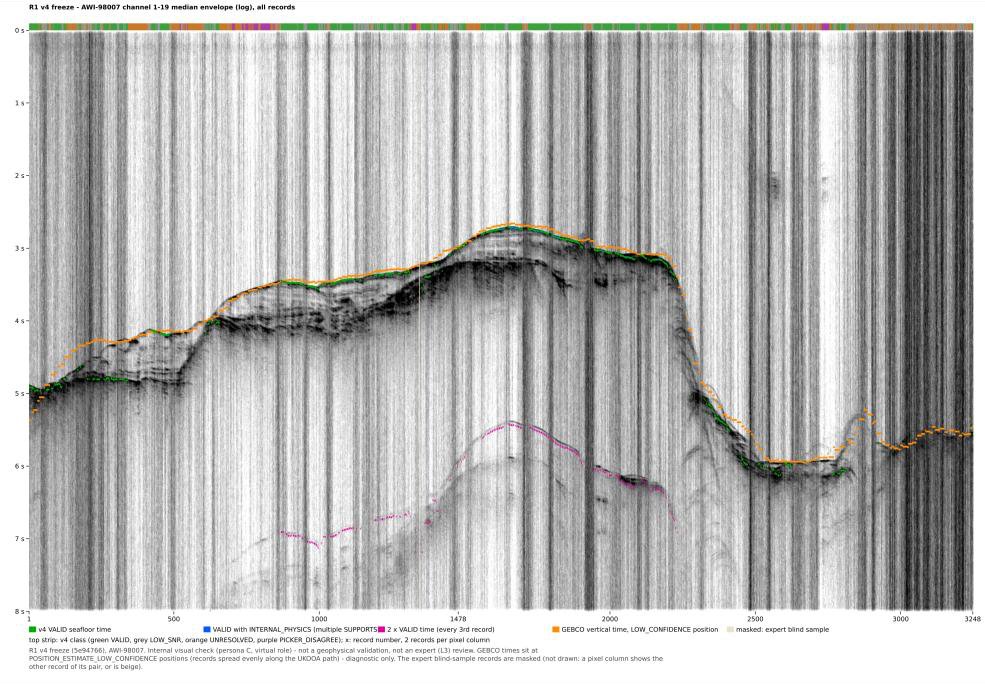
AWI-98007: seabed candidates from the recorded signals (green) against GEBCO bathymetry converted to sound travel time (orange). Actual internal result. The vertical axis is travel time, not depth; approximate survey positions limit precise depth-error claims.
File structure, headers, channel roles, missing samples, inconsistent acquisition information, frequency content and continuity — checked before a processing decision depends on them.
VYRA flags extra sound-path bounces that can imitate useful reflections, compares the waveforms and retains uncertain cases for review.
A synthetic seismic framework sets layers, sound speeds, noise and echoes, runs the same engine and checks the result against a protected reference.
From existing 2D lines to a projected 3D view.
A conventional 2D survey samples narrow sections through the subsurface. P3D — a separate research track — estimates the structure between those lines to build a regional volume, so teams can explore possible layer continuity across a block for screening and acquisition planning.
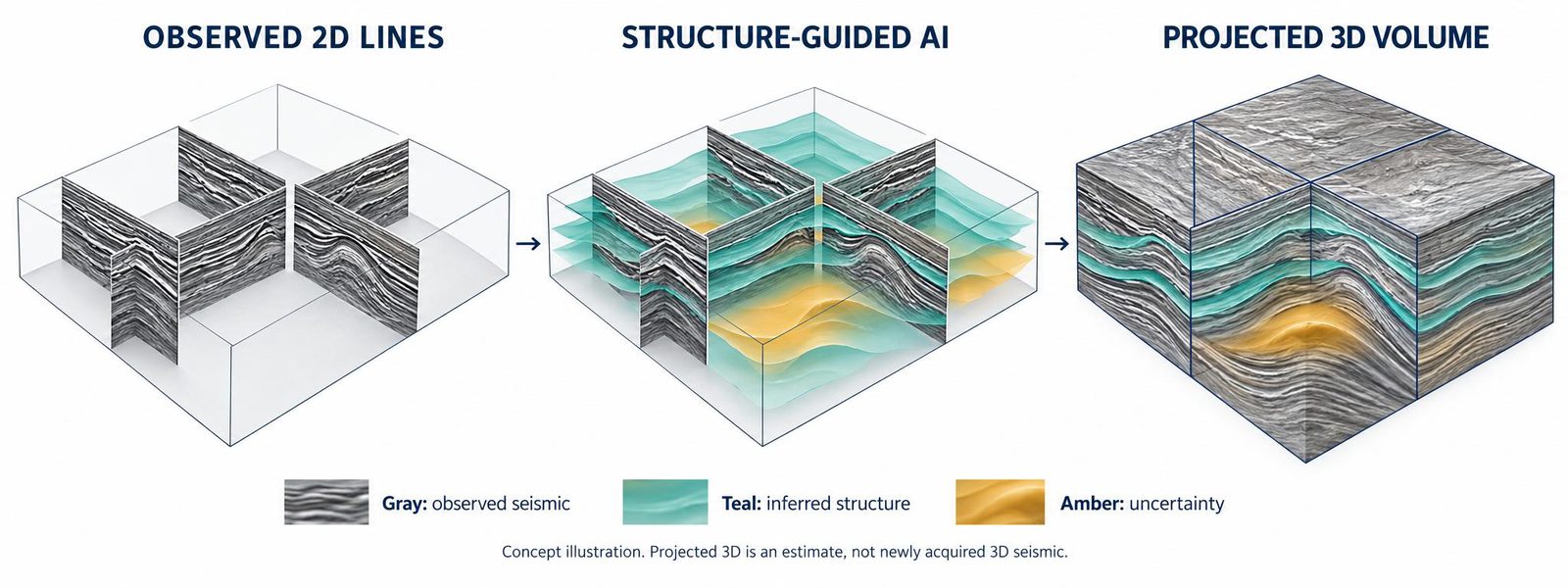
- 01Build a baselineStructure-aware interpolation with a simple, reproducible benchmark.
- 02Compare learned approachesTrain only on authorized data; test on the same withheld lines and areas.
- 03Measure uncertaintyReport accuracy by line spacing, geological complexity and distance to observed data.
- 04Release a bounded productPreserve observed inputs, expose unsupported areas and obtain expert acceptance.
Concept illustration. Projected 3D is an estimate between measured lines, not newly acquired 3D seismic.
Ask about the structure on screen.
A familiar chat interface connects the selected 3D region to expert advice. Six specialist AI advisors share one knowledge base for the block — surveys, wells, interpretations, model versions and reviewed findings — and call validated tools to answer.
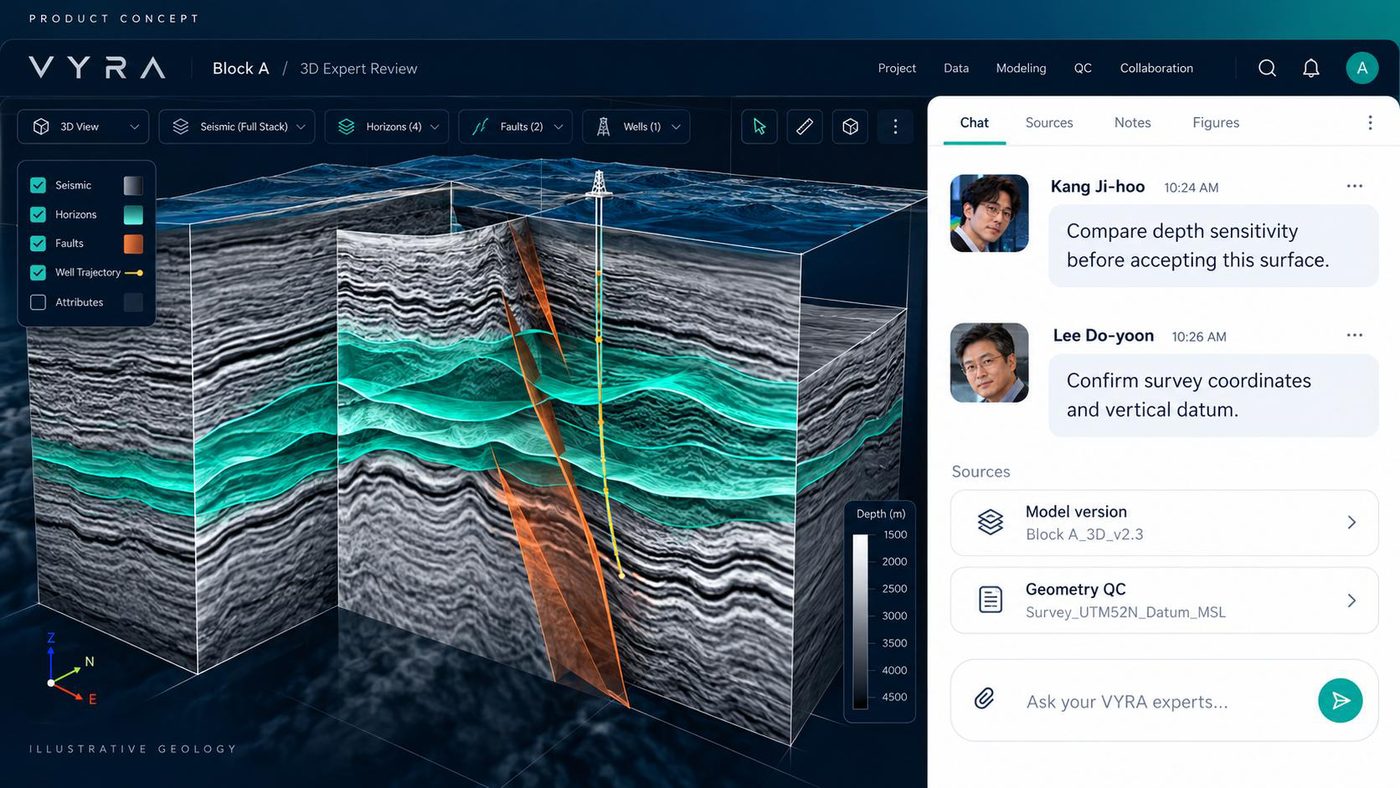
Product concept. Fictional AI advisor personas; human teams retain decision authority. Large seismic jobs run asynchronously and show their status, cost and data timestamp.
 An ORYXA brand · therestiq.com
Restaurants should
own their customer
relationships.
Restiq is a restaurant relationship intelligence platform. Kiosk, POS, AI CRM, membership — built so the operator owns the customer asset, not the aggregator.
"Acquiring a customer is expensive. Retaining the relationship is the asset."
 An ORYXA brand · creative automation
Marketing
that operates itself.
Restiq Studio is the creative automation surface for restaurants already running on Restiq. AI-generated videos, menu systems, social content and campaign automation — all wired to live customer behavior.
Built in the
SPC Free Zone.
ORYXA is a UAE-registered platform group operating under the SPC Free Zone — designing AI-based digital infrastructure for enterprises across MENA, APAC and Europe.
Software development
enterprise platforms · AI systems
Cloud computing
infrastructure · orchestration · data
Cyber security architecture
enterprise-grade protection by construction
Enterprise AI consulting
strategy · readiness · execution